
Bring what you have
Your equipment list, provider reports, lab certificates, spreadsheets or a CSV/XLSX export from your current software.
Inspection readiness
Stop assembling the equipment story only when somebody requests it. FD Maintain organizes documented tests, repairs, current source files, due obligations and missing evidence by equipment and requirement.
Recorded evidence against cited requirements. Not a certification of compliance and not legal advice.
 NFPA
 DOT · PHMSA
 NIOSH
 IL OSHA
 OSFM
We have helped departments get ready for the records request long before the inspector arrived.
The Readiness Baseline
Bring your department’s equipment list and existing service records. FD Maintain brings them together, identifies documented service, upcoming requirements and evidence gaps, and prepares a practical readiness report. See which equipment has supporting documentation, which records still need attention, and what to do next — without replacing your existing department software.
A Readiness Baseline reports recorded evidence. It is not a certification of compliance; qualified personnel determine applicability and equipment fitness.
Get your Readiness BaselineYour equipment list, provider reports, lab certificates, spreadsheets or a CSV/XLSX export from your current software.
Each record is tied to the right piece of equipment with its source and date. Unclear matches are reviewed with you, never guessed.
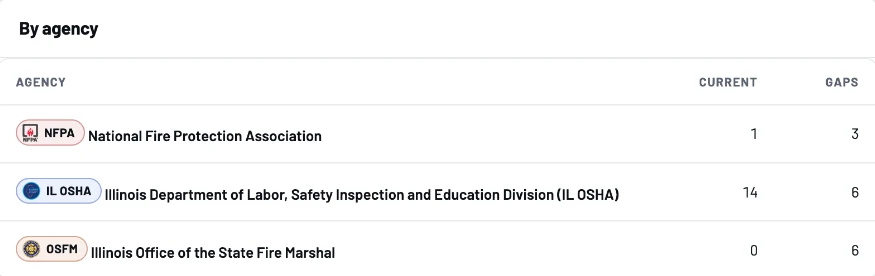
Documented service, upcoming requirements and evidence gaps, by equipment and by agency.
What is supported, what still needs attention and what to do next, organized by agency.
From request to packet
An inspector, insurer or board asks for the equipment story. The answer should already exist, with its gaps stated plainly.
“Show me the supporting records for these serial numbers and this period.”
A source-linked timeline for every piece of equipment: authorized records, dates and actual results.
A separate, plainly labeled list of missing, not shared, deficient and overdue evidence.
Responsible officer, open action, assigned provider, appointment and reviewed closure.
A packet organized by agency, with an index, sources and the original files.
A folder is a collection
Thorough records can still be hard to use when the request comes. The difference is whether each record is attached to the right equipment, requirement and action.
| When the request comes | A folder full of PDFs | Evidence attached to the right asset, requirement and action |
|---|---|---|
| Finding the record | Open files until the right one turns up | Open the equipment; every record is listed with its source and date |
| Knowing what is missing | Unknown until someone notices | Listed plainly as missing, not shared or not verified |
| Failed results | Filed beside the passing ones | An open issue with an owner until proof closes it |
| Who produced it | Whatever the PDF happens to say | Provider, technician or lab, the date and the trust level on every item |
| Handing it over | Copied and assembled by hand | Organized by agency, with the original files attached |
The deliverable
Choose the stations, equipment types, agency and date range. The packet is generated from the records themselves, and every export is logged.
Explainable · traceable · defensible
Every readiness conclusion is explainable, traceable to its underlying evidence, and defensible when that evidence is challenged. A status is never just a color.
Who sees what: department, provider and authority access is scoped by role and by explicit sharing. A tag scan shows only the equipment’s public summary.
Open any status to see the source record behind it, who produced it, the date, and the citation it answers.
Completed provider work and lab certificates are marked verified. Records your department reports are labeled as department records, so nobody mistakes one for the other.
When two records for the same equipment disagree, both stay visible and the conflict is flagged for review. Any source can show a problem; only strong sources can prove it is fine.
The guardrails
FD Maintain organizes what the records support, what is missing and what action is needed. Whether a requirement applies, which edition your jurisdiction has adopted and whether equipment is fit for service remain decisions for qualified people and the responsible authority.
Read the fire department readiness guideGood questions
Yes. Choose an agency represented in the Standards Library, and the packet lists the corresponding equipment evidence, exceptions and corrective actions in citation order. Confirm that the selected requirements apply to your department.
It is listed as missing in the packet, not left out. If a provider holds the record but has not shared it, it is listed as not shared.
No. It reflects recorded evidence against cited requirements and says so plainly. Applicability, adopted editions and equipment fitness are decided by qualified people and the responsible authority.
Yes, and they are labeled. Each item shows whether it is verified by a provider or lab, supported by a confirmed original, or reported by the department.
Let’s make the work easier
Bring the records you have. We’ll show you what an inspector would see, and what is missing.