Air-quality testing
Know what the lab actually reported.
A breathing-air certificate is only useful if you can find it, trust it and act on it. FD Maintain ties each lab result to the compressor it came from, shows the next sample due, and follows a failed sample through to a passing retest.
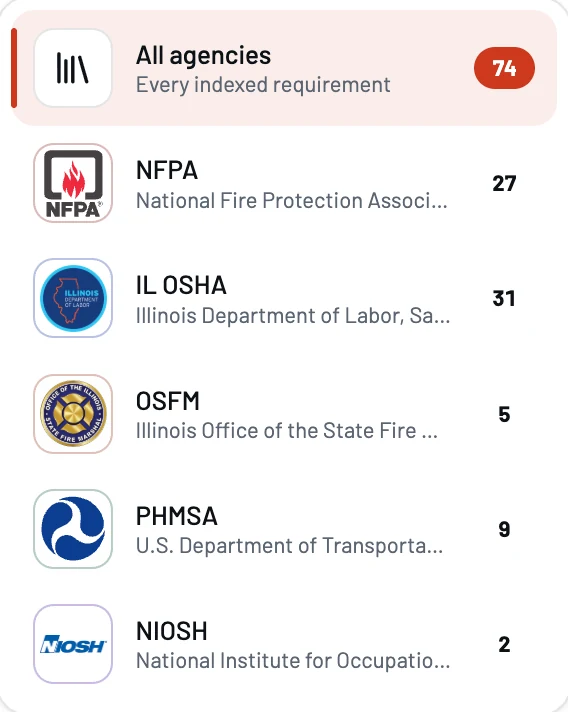 74 requirements · 6 agencies
We know the breathing-air business.
Breathing air is our home ground: samples, compressors and the records in between.
From sample to record
Follow an air sample from the compressor to the record.
Each certificate keeps where the sample came from, which laboratory analyzed it and what it reported.
- Sample taken
From the compressor or fill point, by your provider or your team.
- Lab analysis
An accredited laboratory reports the result.
- Certificate recorded
Imported from the lab, or uploaded and confirmed, with the result as reported.
- Linked to its source
Tied to the compressor and air system it came from.
- Next sample due
From the requirement’s interval or your provider’s schedule.
A failed sample opens an issue. Corrective service, a retest and an authorized review close it, and the failed certificate stays on the record.
What the requirements say
The citations behind breathing-air testing.
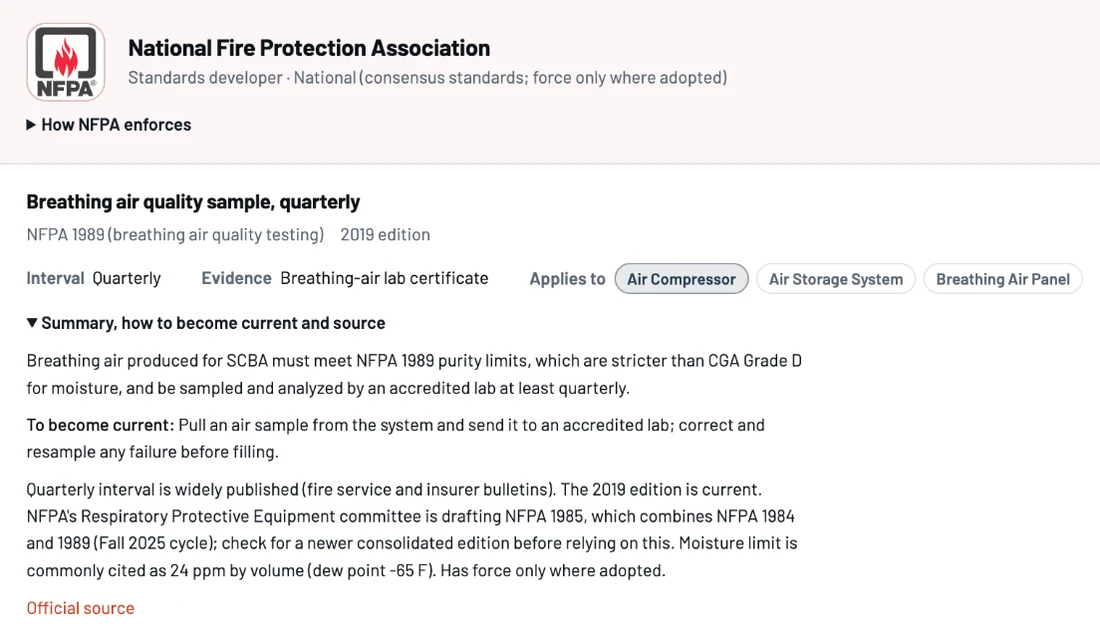
OSHA sets the air-quality limits but no sampling interval. NFPA 1989’s quarterly sampling is the usual way departments show their air meets them, where it has been adopted.
Summaries paraphrase the requirement index reviewed October 6, 2026. Consult the official text; applicability depends on your equipment and what has been adopted.
| Citation | Agency | What it asks for |
|---|---|---|
| NFPA 1989 (2019) | NFPA · binds where adopted | Air sampled and analyzed by an accredited lab at least quarterly, meeting purity limits stricter than Grade D for moisture |
| 29 CFR 1910.134(i)(1)(ii) | Applicable workplace-safety program; confirm local coverage | Breathing air meeting at least Grade D (ANSI/CGA G-7.1-1989) |
| 29 CFR 1910.134(i)(4)(iii) | Applicable workplace-safety program | Cylinder air moisture at a dew point of −50 °F or lower |
| 29 CFR 1910.134(i)(5)–(i)(7) | Applicable workplace-safety program | Compressor filter and sorbent maintenance with a change tag, carbon-monoxide limits and alarms |
Verified versus reported
An imported lab certificate is verified evidence.
Certificates imported from the laboratory carry full weight. A certificate your department uploads counts once the original is attached and confirmed by an officer, and it stays labeled department-supported. A failed result counts from any source.
Follow a failed air sample to closureGood questions
A few things worth knowing.
Which laboratories are supported?
Certificates in supported laboratory formats are imported directly. A certificate from any other lab can be uploaded as a department record and confirmed by an officer.
Does a passing sample mean the air is safe to use?
A passing result is evidence about the sample on the date it was taken. Operational decisions remain with authorized department personnel.
Let’s make the work easier
Know what the lab reported, for your own compressor.
Bring your last few air certificates. We’ll show you the record, the next sample due and any gaps.